“I can’t believe that they just got a brand new TV. Don’t they have government assistance for food? If only they could see that they would be ahead by saving that money…”
“Did you see that person who was asking for money by Wal-Mart? I saw that they had a nice tablet they were watching something on when they weren’t asking for money…they’re hurting people’s view of the REAL homeless people.”
I’m sure that we have all heard some version of this before, or we have personally felt something similar whenever we think to buy ourselves something nice. “If I don’t have enough money to buy a home, why am I getting a nice pair of shoes?” While, in a vacuum, the math seems to check out, I think that a little inspection of the sentiment may uncover a different truth.
In the disability community, we talk about the “models” that a person or institution can view disability status. There is the medical model, the social model, and the moral model. For this writing, I will be focusing on the moral model (but I recommend you look into the others if you interested in disability rights and culture). In the moral model, a person’s disability status is seen as a cause of their own moral failing. “Their disability is based on a moral failing. Their disability is punishment for their failure to adhere to some standard. I’m not disabled because I’m better and make the right choices.”
In this way, I think the way that we talk about the financial decisions of others is closely aligned with this moral model. This is where we need to introduce the next factor in this comparison: the idea of a financial meritocracy in the United States.
While there are some exceptions, most mega-wealthy individuals in our culture are people who have never had to work at the same level of dedication and “personal grind” that the average person puts in on a weekly basis. They have never had to go to a job and do hard labor for 40 hours a week and then go home and decide if they were going to pay rent or for their medicine for the month. Yet, even knowing this, we look at these people as paragons of judgement and a status that we should all strive to achieve. If we work hard and save our money, one day we can rise to the level of the millionaires of our society. If we keep grinding, that life can be for us too.
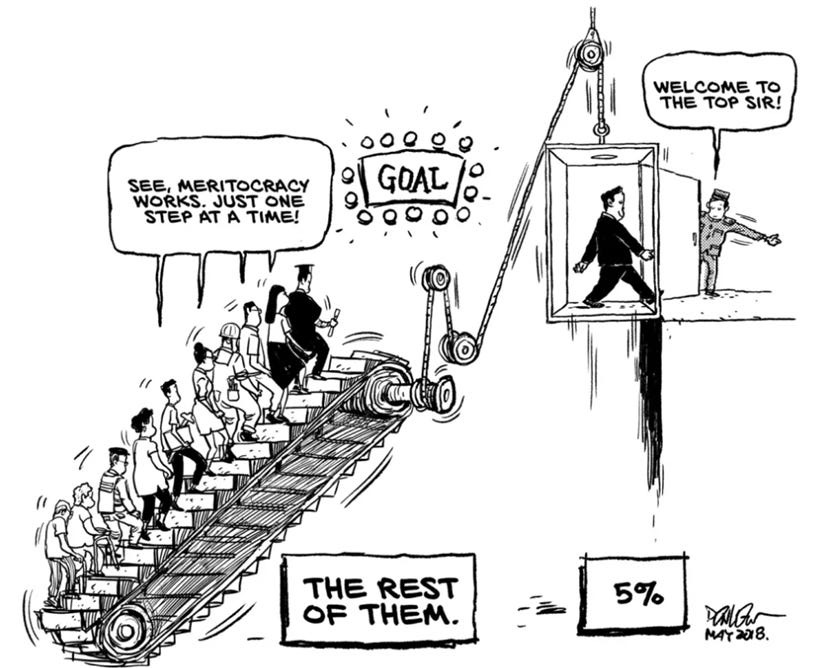
In Christianity, the prosperity gospel teaches that those who are smart with their money and give to their churches and to the mission of gospel will be rewarded in financial security. In this system, we have effectively tied morality to a person’s financial status. If you are poor, you did something wrong. The rich are there because of their personal merits.
Before I go any further, I want to say that I don’t blame people for feeling that way. We have been socialized to believe these things because it makes us blame ourselves for our pain as opposed to the top 1% of our population who hoardes the majority of our wealth. If they can keep us fighting amongst ourselves, we are less likely to look to the root of the issue and then follow it all the way to their positions above us.
Now, back to our example, a person who wants to buy themselves a nice TV is now made to be a public spectacle and target of ridicule. By commenting on the purchases of others, a person can feel like they are smarter and more worthy to become a member of the upper crust of our society. They feel as if they are proving their merits for success by being critical of others.
Now that we understand the POV of the person on the outside, let’s do something few do and put ourselves in the shoes of the person buying the TV. That person may not have much to look forward to in their life after work is over. They may have a favorite TV show or video game that helps them escape their crappy situation and feel the weight of the world lift off their shoulders. They may have kids that they hope to entertain and allow them to have a nice setup like the kids at their school so they don’t get made fun of when people come over. They could simply want a new TV. Who are we to judge this person? if they were to save that $300 and keep using their current TV, what do you think that $300 is going to get them? Is $300 going to feed their family? Not for very long at all…I venture to say that’s less than a single trip to the grocery store. Is it going to send their kids to college? No. Even if they put that in a savings account, it’s only going to earn them around $12 if it sits there all year. Is their happiness for the year worth less than $12? If they spend their money on things that make them happy, what harm has the caused any of us?
If we do this kind of moralizing our whole lives, what have we accomplished? If I go my whole life optimizing for a future that may never come, what have I done? I’ve lived a life of misery on the idea that I may one day have the privileged opportunity to buy a nicer car or nicer home? What about the 40-50 years of misery it took for me to get there? What if I never make it to be old enough to see any of it pay off? I’ve sacrificed my whole life at the altar of upward mobility.
The idea for this post came from my time reflecting on my habit of purchasing technology. I am someone who appreciates my gear but also values having pretty modern tech. I will buying a new iPhone next month (I’ll be posting about that later), and during my time of reflection of my motives, I have been on Reddit and have observed the way people talk about upgrades and evaluating new technology.
The first thing that I saw was a fetishization of holding onto a device as long as possible. People who have the most upvotes are those who post that they are upgrading from very old iPhones, some saying they haven’t upgraded in 8-9 years. They speak proudly of all the times that they have to charge their phone each day. They speak in high regard about how the cameras aren’t cutting it and how the screens aren’t what they wanted.
Most of the conversation surrounds how frugal and smart these people are. How they are the smartest and most resourceful around us…and all else being the equal, I would agree. The only problem is they have been living with something that they admit has been terrible for years. How much stress have they caused themselves as they have to find an outlet in each new room that they go into. How many memories could they have captured better with a camera that isn’t fuzzy in low-light? In these discussions, struggle is moral and confidence is vain. At a certain point, we not longer hold people to that standard. For the wealthy, buying a $500,000 car is just the spoils of a life well lived, Rolex watch collecting is just a harmless hobby, and a closet of purses is just fine.
As you go through your day, I ask that you take a conscious look at the judgements we make about others. Why are we making those judgments? Who is this judgement serving? Why is a person’s new TV your business?

